Realizing that your elderly dog does not want to eat often causes immediate anxiety.
A normal appetite is one of the main signs of good health. When it changes, something may be wrong.
In young dogs, a slight change in appetite may not mean much, as long as it returns to normal the next day, for example.
In the senior phase, any change deserves attention.
But it is important to understand one thing: not every reduction in appetite means something serious. And not every refusal to eat is just "a sign of aging."
Our geriatric veterinarian, Dr. Rita Zuanaze, emphasizes that older dogs that start to become more selective about food, refuse food, or show weight loss need to be closely monitored and taken to the vet for a complete evaluation, preferably with a geriatric focus.
“A decrease in appetite should not be seen as something ‘normal for age,’ as it may be related to simple situations such as toothache, mouth sores, or periodontal disease, but it may also indicate more serious problems such as kidney failure and other metabolic diseases.”
“In addition, it is important to assess the environment: many older dogs experience joint pain or have difficulty bending down, and something seemingly simple—such as adjusting the height of the food bowl—can make feeding easier and improve appetite. Early investigation makes all the difference in maintaining health and quality of life at this stage.”
Next, you will learn about the most common causes, how long an elderly dog can go without eating, and how to act in the safest way possible.

Is it normal for older dogs to eat less?
With aging, the body undergoes natural changes.
For example, metabolism slows down, energy expenditure decreases, and the sense of smell may become less sensitive.
This may lead to a slight reduction in the amount ingested.
What is not considered normal is:
- To stop eating completely
- Refusing food for more than 24–48 hours
- Show complete disinterest in any type of food
There is an important difference between "eating a little less" and "not wanting to eat."
This distinction completely changes the conduct.
Why won't my elderly dog eat?
Loss of appetite in older dogs almost always has a cause. It can be simple or complex. Transient or progressive.
Among the main reasons are conditions that often develop silently.
Dental changes
Dental problems are extremely common in older adults.
Advanced tartar, gingivitis, pain when chewing, or even fractured teeth make eating uncomfortable.
Many guardians interpret this as "fussiness," when in fact there is pain involved.
If the dog approaches the food but gives up after trying to chew, this is a strong indication of an oral problem.
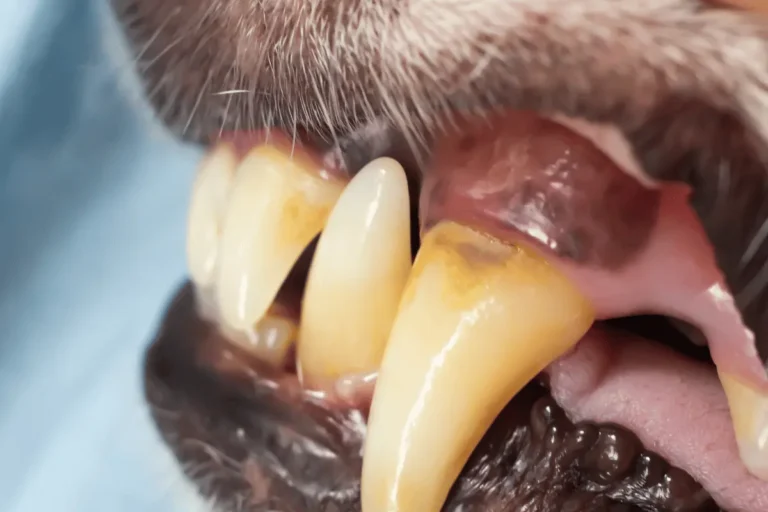
Dog with tartar
Chronic pain
Dogs with osteoarthritis or other joint diseases may avoid getting up to go to the potty.
Pain does not need to be related to the mouth to interfere with eating.
Often the animal wants to eat, but the physical effort discourages it.
Chronic kidney disease
This is one of the most common causes of loss of appetite in older dogs.
Kidney disease can progress silently for months or years.
When appetite begins to decline, there is often already significant metabolic impairment.
Other signs may include:
- Increased water intake
- Urinate more
- Weight loss
- Nausea
Liver diseases
Changes in the liver can also cause anorexia, nausea, and general malaise.
The problem is that many symptoms are subtle at first.
Loss of appetite may be one of the first signs noticed by the guardian.
Cancer in older dogs
Unfortunately, the risk of neoplasms increases with age.
Tumors can cause loss of appetite due to:
- Pain
- Inflammation
- Metabolic changes
- Organ compression
There are not always other visible signs at the beginning.
Cognitive changes
Canine cognitive dysfunction syndrome can lead to disorientation and behavioral changes.
Some dogs forget routines, including feeding times. Others lose interest in activities that were once enjoyable. In some cases, this may be related to Alzheimer's disease in older dogs, which alters behavior and routine.
In addition, a dog's lack of appetite may be related to depression.
How long can an elderly dog go without eating?
This is one of the most frequently asked questions by pet owners. The answer depends on the animal's overall health.
In general terms:
A healthy dog can safely go without food for up to 24 hours.
After 48 hours, metabolic risk begins to increase.
More than 72 hours without food intake is already considered worrisome, especially in the elderly.
If you are facing a situation where "my dog hasn't eaten in 5 days," this is a veterinary emergency.
In older dogs, muscle loss occurs rapidly. Dehydration sets in easily. And the body has fewer reserves to compensate. Therefore, waiting can significantly worsen the condition.
How do you know if your dog is at the end of its life?
That's a delicate question.
Loss of appetite alone does not mean that the dog is at the end of its life.
However, when accompanied by other signs, it may indicate an advanced stage of the disease.
Check for:
- Significant weight loss
- Progressive weakness
- Accelerated weight loss
- Difficulty standing up
- Altered breathing
- Intense apathy
- Lack of response to the environment
The combination of signs is more important than just one isolated symptom. Only clinical and laboratory tests can determine the actual prognosis.
What to do when your senior dog won't eat?
The first guideline is clear: do not force-feed without veterinary evaluation.
However, some measures can help temporarily while care is being organized.
Instead of simply changing the feed repeatedly, it is important to observe the behavior.
He shows interest and then refuses?
Or do you ignore it completely?
Some strategies that can help include:
- Lightly heat the food to intensify the smell
- Offer wet food or softer textures
- Reduce stressful stimuli in the environment
- Check for difficulty chewing and/or reaching food
However, these are palliative measures.
If the cause is kidney disease, liver disease, or chronic pain, simply changing the texture or palliative measures will not solve the problem.
What can I give my senior dog to stimulate his appetite?
Many guardians look for quick fixes, but stimulating appetite without treating the cause can mask a serious problem.
In some specific cases, the veterinarian may recommend:
- Individualized nutritional adjustments
- Nausea control
- Pain management
- Appetite stimulant medications
However, these resources should be used judiciously and under the guidance of a veterinarian. The priority is always to identify the reason for the loss of appetite.
When should you seek immediate care?
There are situations that require urgency.
Seek help if there is:
- Frequent vomiting
- Severe diarrhea
- Accelerated weight loss
- Extreme lethargy
- Dehydration
- Abdominal pain
- More than 48 hours without eating
The sooner the cause is identified, the greater the chance of effective intervention.
The importance of monitoring in the senior phase
In the senior phase, small changes—such as reduced appetite—can be the first signs of significant metabolic changes.
PetMoreTime operates based on science and objective data to help guardians and veterinarians monitor the health of older dogs continuously and preventively.
With structured monitoring and a focus on longevity, it is possible to identify risks before they develop into advanced diseases.
If your dog has already entered the mature or senior stage, this is the ideal time to start monitoring strategically.