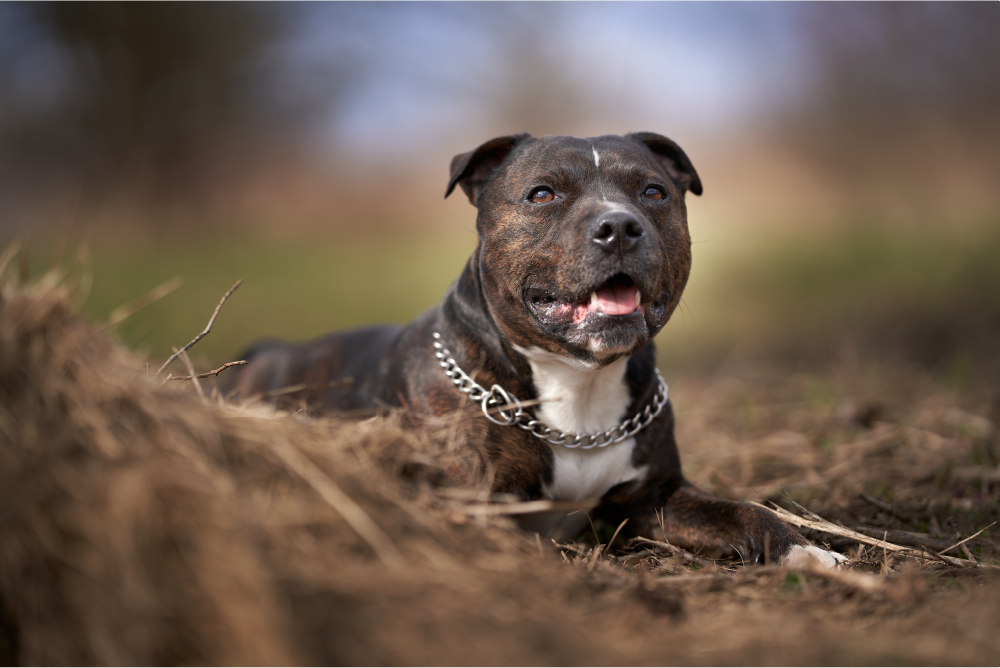
Staffordshire Bull Terrier: Life Expectancy and How to Extend Their Lifespan

The Staffordshire Bull Terrier, affectionately known as the “Staffie,” is a dog of fascinating contrasts.

With a powerful build that reflects its historical roots in England, it is, in fact, one of the most affectionate and people-oriented dogs around.

Nicknamed the “nanny dog” in its country of origin for its patience and love of children, the Staffie is a bundle of energy and loyalty, living to please its owners with a big smile and a tail that wags with joy.

Characteristics of the Staffordshire Bull Terrier

🐕 Size: Medium
🐕 Average weight: 11 kg to 17 kg
🐕 Height: 35 cm to 40 cm at the withers
🐕 Genetic predispositions: L-2-HGA (metabolic disorder), hereditary cataracts, and hip dysplasia
🐕 Body structure: Stocky, extremely muscular, with a broad chest and strong jaws
🐕 Coat: Short, smooth, and close to the skin; various colors such as red, fawn, white, black, or blue, with or without markings

How long does a Staffordshire Bull Terrier live?

Staffordshire Bull Terrier

The average life expectancy of a Staffordshire Bull Terrier ranges from 12 to 14 years.

This breed is considered robust and hardy, but its longevity is directly linked to weight management and joint health.

The Staffie is a dog with boundless energy, which can mask pain or injuries.

The key to ensuring he reaches old age in good health is striking a balance between vigorous exercise (essential for his mental well-being) and proactive monitoring for specific genetic conditions. A well-cared-for Staffie, with a healthy weight and a mentally stimulated mind, is a companion who typically ages with great dignity.

Staffordshire Bull Terrier

Check your dog's aging curve

Want to know how to improve your dog's quality of life as they age?

PetMoretime specializes in veterinary gerontology and offers a personalized longevity program for your dog.

WhatsApp

Common Health Issues in Staffordshire Bull Terriers

Age-related health conditions in the Staffordshire Bull Terrier

Signs of Aging in the Staffordshire Bull Terrier

Staffordshire Bull Terrier
Reluctance to play "tug-of-war": Staffies love to use their strength; avoiding tug-of-war games may indicate pain in the spine or joints (osteoarthritis).
Difficulty getting onto the couch or bed: The stiffness caused by dysplasia or osteoarthritis turns what were once explosive jumps into slow movements.
Eyes with a bluish or cloudy appearance: This indicates the development of cataracts, which can progress and significantly impair vision in older adults.
Appearance of lumps or masses: Due to the incidence of neoplasms in this breed, any new swelling under the short coat should be examined.
Confusion or barking at nothing: Signs of canine Alzheimer’s (cognitive dysfunction), affecting the animal’s memory and spatial awareness.
Less response to noises or calls: Progressive hearing loss is common in older dogs, making them seem more "inattentive" than usual.

Most of these diseases begin silently.

PetMoretime can track and prevent diseases before they appear through continuous monitoring.

WhatsApp

Behavior of the Staffordshire Bull Terrier

Sociability
Trainability
Energy level
Motivation for food

Lifetime cost

In addition to the initial investment, it is important to consider:

Quality food
Veterinary consultations
Vaccinations and tests
Possible orthopedic or cardiac treatments

How to Increase the Life Expectancy of a Staffordshire Bull Terrier

To increase the Staffordshire Bull Terrier’s lifespan, strict weight control is an absolute priority, as being overweight is devastating for their compact joints.

Maintaining a routine of moderate, regular exercise helps preserve the muscle mass that supports the skeleton.

Semi-annual check-ups focused on cancer screening and eye health are vital as we age.

Because this breed is extremely devoted to its owner, environmental enrichment and ongoing training are the best ways to slow the progression of canine Alzheimer’s by keeping their brain active. In addition, daily dental care helps prevent systemic infections that can affect vital organs in old age.

dogs

Longevity does not depend solely on genetics.

It can be monitored.

Learn how PetMoreTime monitors markers that indicate accelerated aging.

WhatsApp